STORIES
How Andrew Consolidated His Crypto Payments in One Wallet — Swapcoin Blog
A software freelancer with clients in the US, UAE and Kazakhstan. Three networks, three wallets, hours of manual transfers — until Swapcoin consolidated it all.
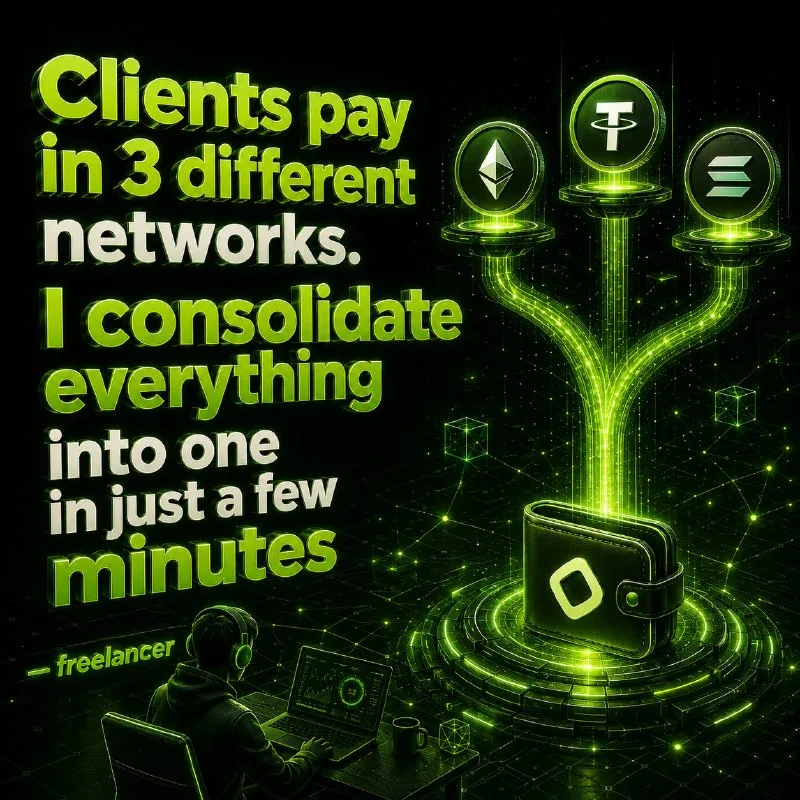
How Andrew Consolidated His Crypto Payments in One Wallet
Andrew, 31, sells software remotely. His clients are spread across the US, UAE, and Kazakhstan — every one of them paying from wherever it is convenient for them.
That convenience added up to a mess. One client sent USDT on TRON, another on BSC, and a third only paid in USDC on Arbitrum. Three networks, three addresses, three different wallets — and every month, the same chore: getting everything into one place.
Andrew's Situation
“For a long time, I accepted payments however I could,” Andrew says. “One client would send USDT on TRON, another on BSC, and a third would only pay in USDC on Arbitrum. I had three addresses in three different wallets, and every time I had to figure out how to consolidate everything into one place.”
His clients were not being difficult — they were being normal. Each of them used whichever network and stablecoin their own bank, app, or preference supported. The fragmentation was simply inherited by Andrew, who had to pay the tax for it every single week.
The freelancer's quiet cost
When your payments arrive scattered across networks, consolidation is not a chore — it is overhead, and overhead eats into the hours you could be billing.
The Old Exchange Round-Trip
Before he found a direct route, Andrew's process was the standard exchange loop, and it was punishing:
- Withdraw from TRON, BSC, or Arbitrum to a centralized exchange
- Wait for the deposit, sell into another asset
- Buy USDT or USDC again on the network he actually used
- Withdraw it back out — paying another network fee
“It used to look like this: withdraw to an exchange, sell, buy what I needed, and withdraw it back. Several days for the whole process. Fees, spreads, waiting.” Several days to move money he already owned — with fees on every step that existed only because an exchange stood in the middle.
Consolidating in One Transaction
Everything changed when Andrew found Swapcoin. Instead of the exchange loop, he could consolidate — moving USDT from TRON and USDC from Arbitrum into a single wallet in a few minutes, with a single transaction.
“Now I have one rule: receive a payment — consolidate everything into USDC on Base. One transaction, one fee, and I know exactly how much I've earned that month.”
That rule does more than simplify accounting. It turns an unpredictable pile of fragments into a predictable single balance, in a stablecoin on a network whose fees are cheap and reliable. It works because Swapcoin routes across networks directly; your first cross-chain transfer follows the same five steps Andrew uses today.
From Payments to Portfolio — All in One Place
The same approach extends past incoming payments. Andrew keeps his business and personal holdings visible in one dashboard, so a “how much did I make this month” question takes seconds instead of an afternoon of reconciliation.
Recently, a client asked to pay part of the contract in SOL. He met them there: “I paid from USDC on Base. Same thing — one transaction. 40 seconds.”
If you accept payments across networks, the freelancer playbook — a crypto treasury for independent workers — covers the full setup, from choosing a destination network to converting rewards without an exchange.
Time Is the Real Payment
The numbers that matter are not the fees — they are the hours. Andrew estimates his manual consolidation used to eat a meaningful chunk of his week. Those hours are now back in his calendar, and for a remote seller, an hour is not a cost, it is billable work.
Your time is worth more than the fee on a bad route. The direct route is the difference between spending the week moving your own money and spending it on your business. Check the pairs that would matter for your own workflow — most people are surprised at how many of them fit.
The Monthly Close in Five Minutes
Andrew schedules a single weekly ritual: Friday, ten minutes, consolidate everything into USDC on Base. The whole month becomes a series of small, predictable moves instead of one painful reconciliation at the end. His bank statement equivalent is a list of three or four transfers with identical fees — readable, provable, and ready for a tax file or an accountant.
That discipline matters because fragmented payments have a way of becoming invisible. A payment received on a network you rarely open can sit for weeks, quietly, in a balance you forget you have. Consolidation on a schedule turns those forgotten fragments into working capital —
And the routine is deliberately dull — that is exactly what makes it possible to repeat every single week without thinking.
and makes the numbers you report to yourself and your accountant match reality.