Comparison
Bank vs Exchange vs Swapcoin — The Same $10,000 Transfer — Swapcoin Blog
A bank transfer costs $200-300 and takes 3 days. An exchange takes 40 minutes with verification. Swapcoin costs $10 and takes 30 seconds.
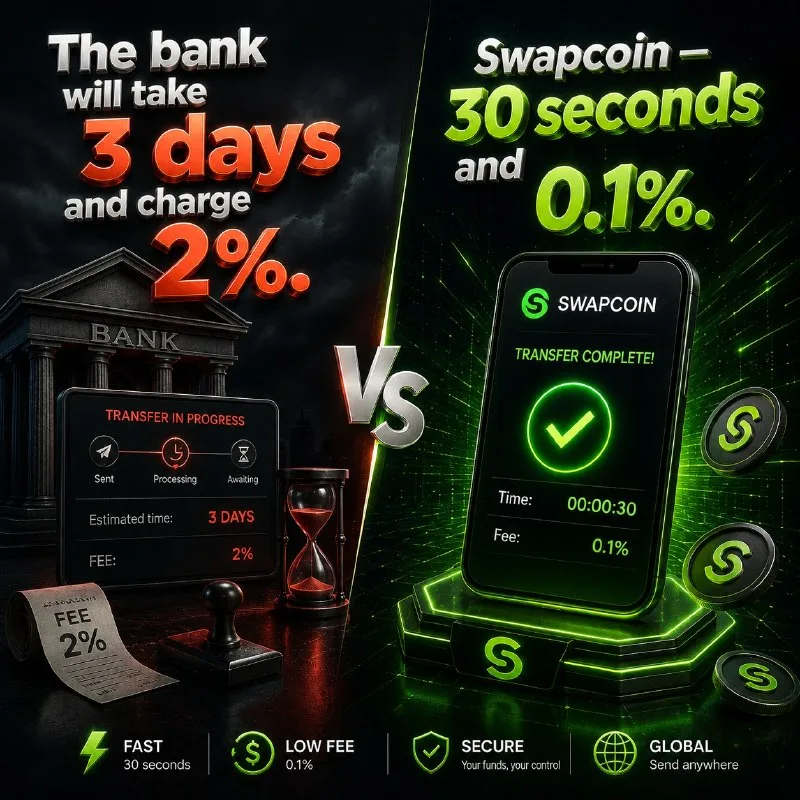
Bank vs Exchange vs Swapcoin — The Same $10,000 Transfer
Let us honestly compare two worlds of moving money: the old one built around banks and centralized intermediaries, and the new one built around self-custodied crypto. We will test both on the same transfer — moving $10,000 — and look at time, cost, restrictions, and control.
The $10,000 Test — Bank Transfer
Start with the world most of us grew up with. A large bank transfer still has the structural design of a 1970s interbank network, wrapped in modern accounts.
- Time: 1–3 business days
- Fee: 1–3% plus a hidden exchange-rate markup
- Restrictions: business hours, weekends, daily limits, and fees from every correspondent bank in the chain
- Control: the bank can freeze the transfer, request documents, or reject it
The hidden exchange rate deserves special attention: your “1% fee” often masks a spread of another 1–2% that never appears on the invoice. The true cost of that transfer rarely matches the sticker price.
The $10,000 Test — Centralized Exchange
The second option is the crypto world's answer to the bank: a centralized exchange with its own ledger, its own withdrawal queues, and its own compliance department.
- Time: 10–60 minutes plus withdrawal processing
- Fee: 0.1–0.5% trading fee + spread + network withdrawal fee
- Restrictions: KYC and verification, withdrawal limits, maintenance on weekends
- Control: the exchange can block your account at any time and require additional documents
An exchange is faster than a bank, but it still sits between you and your money. When the platform has a maintenance window, a review queue, or a policy change, your transfer waits — not because the network needs it, but because the intermediary decides so.
The pattern behind both
Bank and exchange share one design: an intermediary that can hold, delay, or block your money. The only difference is how politely they explain it to you.
The $10,000 Test — Swapcoin
The third option removes the intermediary from the transfer equation. Swapcoin routes the transaction directly between your wallets — the asset never sits in a company account, customer queue, or review queue.
- Time: 20–60 seconds
- Fee: fixed 0.1% + transparent network fees shown before confirmation
- Restrictions: no KYC, no registration, no limits, available 24/7
- Control: full — funds stay with you and you sign the transaction yourself
Move the same $10,000 and the comparison is stark: bank at $200–300 and three days with freeze risk; exchange at $50–100 and forty minutes of verification; Swapcoin at a $10 fee, about 30 seconds, and no questions asked.
Time Is the Hidden Cost
Fees are easy to compare because they are printed on a statement. Time is the cost nobody sums up. Three business days for a bank means the money can move out of your price range while it sits in limbo. Forty minutes of exchange verification is an eternity if the market is moving.
The same transfer, cross-chain and self-custodied, completes in under a minute. That difference matters for everyone — but it is decisive for anyone who moves meaningful amounts with any frequency. Our breakdown of the true cost of a cross-chain transfer shows why even “cheap” routes hide components like slippage and price impact.
Control and Restrictions
Compare the control column and the pattern is clear: each intermediary added a restriction that exists only because the intermediary exists. Business hours, KYC verification, withdrawal limits, account reviews — none of these are properties of moving a token between two addresses.
With Swapcoin, the user holds the keys, reads the route and the fee before signing, and confirms the transaction. There is no account to freeze because there is no account. Our no-KYC explainer covers why we believe that is the design that belongs in crypto.
And because the fee is fixed at 0.1% with no hidden markups, the price you see is the price you get.
Why Crypto Was Built to Eliminate Middlemen
Cryptocurrencies exist to let two parties transfer value directly — no correspondent banks, no ledgers, no account freezes. Bringing a centralized exchange into every transfer brings back exactly the intermediary the technology was designed to remove.
The bank costs more and holds longer control. The exchange is faster but still has a freezing policy. The direct route gives you the speed and keeps the control in your hands. The same transfer, an order of magnitude cheaper and dozens of times faster.
Read the Invoice, Not the Ad
Every intermediary in the old world markets its transfer as simple: one headline fee, one ETA, one happy customer. The actual experience — correspondent fees, rate markup, a hold for manual review — only appears on the statement after the transfer is sitting in its three-day queue.
Direct routing inverts that. Because Swapcoin is a routing layer rather than a ledger, everything you pay (network fees plus a fixed 0.1%) is listed before you sign, not after. The price you confirm is the price the transfer costs, which is the only honest way to compare any two options.