NETWORK
One Dashboard for Every Wallet You Own — Swapcoin Blog
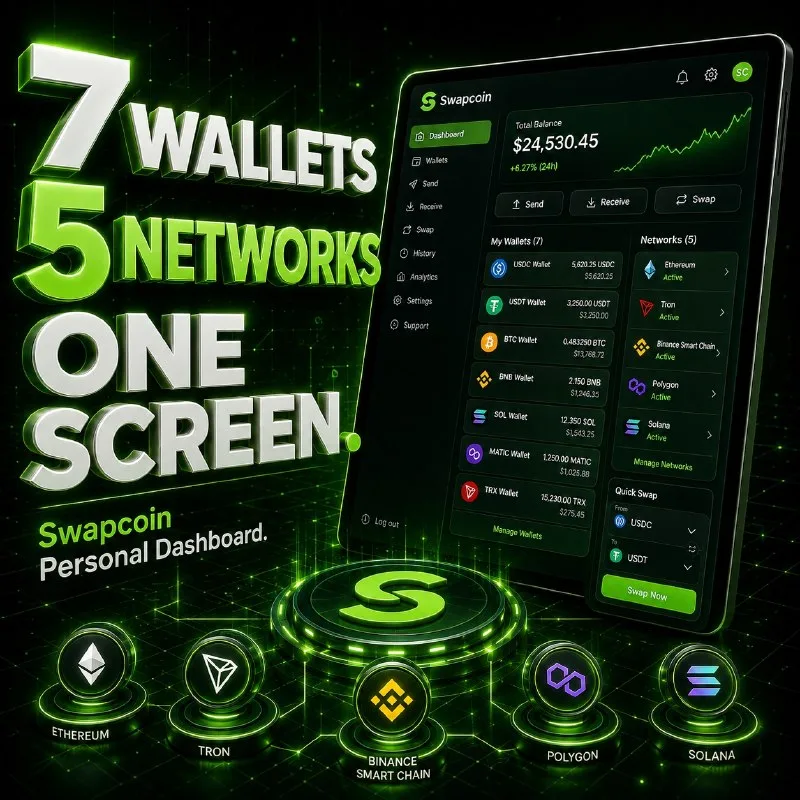
MetaMask, Phantom, Trust Wallet, Ledger — each with its own interface and history. Swapcoin brings all your addresses and balances into a single dashboard.
One Dashboard for Every Wallet You Own
Be honest: how many wallets do you have?
MetaMask for Ethereum, Phantom for Solana, Trust Wallet for BSC, something for Tron... Plus a Ledger for the “serious” holdings and a hot wallet for small, everyday amounts. Each wallet has its own interface, its own addresses, its own transaction history.
To figure out how much money you actually have, you open five apps and add everything up in your head. Then, the moment you need to move something, you search through each app to remember which address holds what, where it can be sent, and how much you can afford to move.
Swapcoin removes that entire second job: all your addresses and balances live in one personal dashboard, and the swap is one more action in the same window.
The Problem With Scattered Wallets
There is a reason people end up with five wallets: different networks grew up with different tools. Solana is natural for Phantom, Ethereum for MetaMask, BSC for Trust Wallet, and cold storage for the assets you are not touching. It made sense at the time.
But the cost of that convenience is constant overhead. Every time you want the full picture of your portfolio, you chase it across apps. Every time you want to consolidate payments — for example, gathering USDT and USDC into one place — you do a little manual accounting first.
One screen instead of six
Connect wallets once, see every network and balance in one window, and manage everything from a single interface. That is the whole point of a multichain aggregator.
One Dashboard, All Your Balances
Swapcoin combines all your addresses into a personal dashboard. You see which networks they sit on, which tokens they hold, and roughly where your money is concentrated — without opening a single other app.
There is no tie to a single service and no holding of your funds. Your addresses remain yours alone. Swapcoin simply gives you a convenient control panel for all of them at once, on top of the swap itself.
If you already track balances across networks, you will find the dashboard familiar — except that it is the same place you also execute the transfer. Learn more about seeing all balances at a glance.
300+ Wallets Supported
You are not limited to one ecosystem. Swapcoin works with over 300 wallets — MetaMask and its many variants, Phantom, Trust Wallet, Rainbow, Exodus, Ledger devices, hardware connections, and the mobile-first wallets people use daily.
That list matters less than the outcome: whichever wallet your asset lives in, it can join the dashboard without a separate setup process, extension, or registration. Connect once, and it stays connected until you choose otherwise.
Swap Without Switching Apps
The real payoff is the workflow. In the past, moving from vision to execution looked like this: decide what to transfer, open the right wallet app, find the right network, find a bridge, chase the rate, confirm in a different interface.
With Swapcoin it is one flow. You see the balance in the dashboard, pick the destination, review the route and the fee, sign, and confirm — all in the same window where you just checked your balance.
Whether you are consolidating payments from clients across different networks or rebalancing between chains, the dashboard becomes the single entry point. Browse the pairs you can move anytime.
A Day Without the Accounting
Consider what a normal Tuesday looks like when every balance is on one screen. You check the dashboard over coffee, see that USDT has accumulated on BSC from a client payment, and notice your USDC on Arbitrum is idle. Two moves, one flow, and by the time the coffee is finished your assets are where they should be — without opening four apps or doing mental math.
The difference is not a nicer interface; it is that the money stops being scattered by default. You no longer have to remember which address holds what, because the dashboard answers it. The routing still happens on the networks themselves, but the orchestration — the part that used to live in your head — is now one screen. For anyone who treats crypto as an ongoing activity instead of a one-time purchase,
A final benefit is subtle: the dashboard removes friction from returning. When your assets are scattered across five apps, checking them becomes a chore you dodge — and an idle balance you forget. When one screen shows everything, you naturally check more often, catch opportunities earlier, and notice drifted allocations before they become a problem. Visibility is not a convenience feature here; it is the mechanism that keeps a multichain portfolio healthy over months. The same principle applies at any scale: a hundred-dollar wallet or a hundred-thousand-dollar treasury both benefit from seeing the whole picture before deciding what moves. Once the picture is on one screen, 'where is my money?' stops being a question that requires an evening of research.
that single screen changes the daily relationship with their assets.