Comparison
Swapcoin vs 1inch vs LI.FI — How They Compare — Swapcoin Blog
The three major DeFi aggregator players. 1inch focuses on EVM swaps, LI.FI on bridges, and Swapcoin combines bridges, DEXs and 60+ networks in one interface.
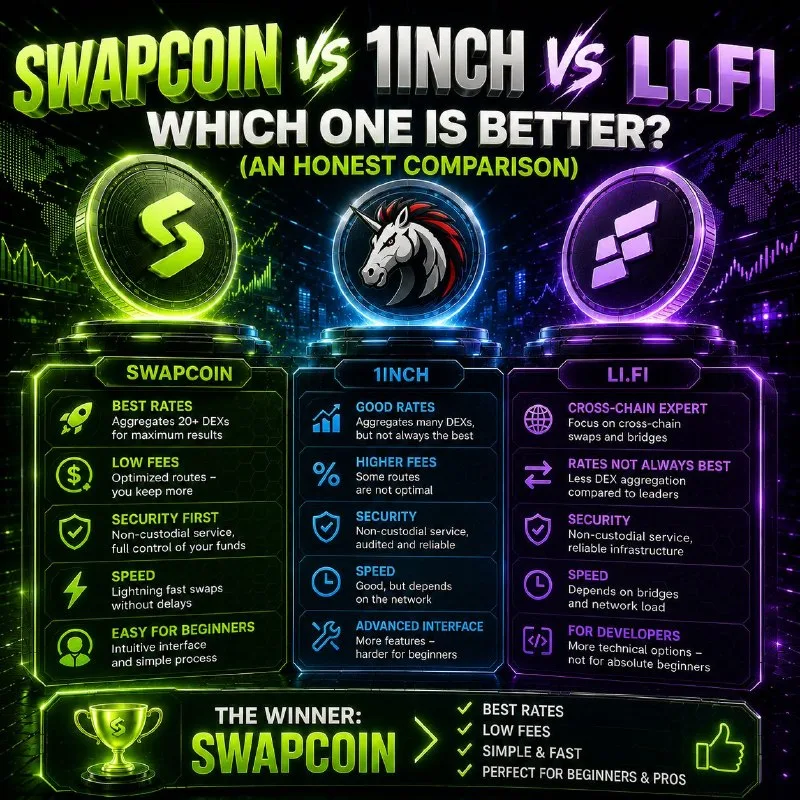
Swapcoin vs 1inch vs LI.FI — How They Compare
The three names at the top of any "best DEX aggregator" or "best cross-chain router" list are 1inch, LI.FI and Swapcoin. They are frequently compared as competitors, but each solves a different slice of the same problem. Once you see the difference in focus, the choice stops being brand loyalty and becomes which tool matches your actual workflow.
What 1inch Optimizes
1inch owes its reputation to EVM single-chain swaps. It compares DEX liquidity on one network at a time and splits your order across the venues with the best combined rate. For a swap on Ethereum, Arbitrum, Base or any other EVM chain, that is its home turf: deep liquidity, tight spreads, deterministic quotes.
Its limit-order book and fusion-style execution made it the default answer to "which swap route on this chain?" Its weakness is exactly its focus — the comparison happens inside one chain, and cross-chain moves are not what the engine was built around.
What LI.FI Optimizes
LI.FI built its name on bridge aggregation. It compares the bridge routes between networks and quotes the fastest and cheapest way across. That makes it the strongest answer to the narrow question "how do I get an asset from chain A to chain B?"
It also introduced Solana support early and a broad network map — genuinely useful for people who live on young chains. The catch is that a move through a good bridge is still a move through a bridge: the swap side of the destination is usually a separate decision, and the bridge spread — the part hidden below the fee — is only one leg of the total.
What Swapcoin Combines
Swapcoin routes across 23 bridges and 25 DEXs in one transaction, which means the something the aggregators do separately is handled as one problem: the path from source asset and source network to destination asset and destination network, optimized end-to-end.
The practical difference is what appears on the confirmation screen. Instead of a bridge quote and a swap quote assembled separately, Swapcoin shows a single receive amount with all legs itemized — the split across venues is part of how the route meets the market.
Where the Difference Shows Up
- EVM-only swap, deep liquidity: 1inch is a natural fit
- Simple token bridge between two chains: LI.FI's strength
- Cross-chain plus the destination swap in one move: where combined routing wins
- Young networks without deep EVM pools: route splitting matters most here
The honest takeaway: none of the three is objectively "better." Each is best at the task its engine was built to minimize. People who do all three kinds of moves usually end up with all three tools — or with one tool that compresses the workflow.
When One Tool Beats Three
A power user answering "how do I route this?" reaches for whichever tool fit the move best. That is fine. Realm mechanics begin to favor an aggregator when every move is a compound one: USDC on TRON to stETH on Arbitrum, USDT on BSC to a Base farm's LP token, a sweep of several chain balances into one treasury position.
For those, chaining three tools costs more than the sum of their fees, because each hand-off quotes from its own starting point — the true cost of a cross-chain transfer shows why the compound route hides the biggest discounts.
The Honest Comparison
There is no winner to crown on paper. The way to decide is to run the same move through two engines and compare receive amounts: 1inch for the pure EVM swap, LI.FI for the clean bridge, Swapcoin for the end-to-end compound route (including the liquid staking rotation and other network-to-network plays). Whichever screen shows the better received total for your exact assets is the tool your wallet should use that day.
The comparison rule in one line
Do not compare interfaces. Compare the receive amount for your exact assets on your exact route.
The comparison habit generalizes far beyond the three tools in the title. Every product that promises "better" 1inch prices, "stronger" bridge aggregation, or "smarter" routing deserves the same test: quote the same move, read the receive figure, keep the winner. Brand reputation matters only at the margin; the quote is the contract, and the contract can be checked.
There is also an ecosystem dimension people skip. A tool's real quality is not static — it shifts with which networks it supports well, which pools are deep this month, and how its splitting logic behaves under stress. A router that was best on Ethereum last year can be middle-tier on Base today. Periodic re-comparison of a few routes you actually use gives you the honest picture better than any review site.
Finally, remember that the comparison is only fair when inputs are identical: same source asset, same destination asset, same size, same gas context. Changes in any of those change the winner, because price impact and spread scale with size and shift with liquidity. The average skill is comparing once; the professional one is knowing the comparison is per-situation, not per-brand.
That per-situation truth is exactly what route engines are built to capture. They keep the venue map live, so the "best router" argument is settled by the market at quote time rather than by an article written last quarter.