Strategies
Three DeFi Strategies That Only Work If You're Multichain — Swapcoin Blog
Yield arbitrage, liquidation hunting and DEX arbitrage — each requires moving capital between networks fast. Multichain isn't nice-to-have, it's an advantage.
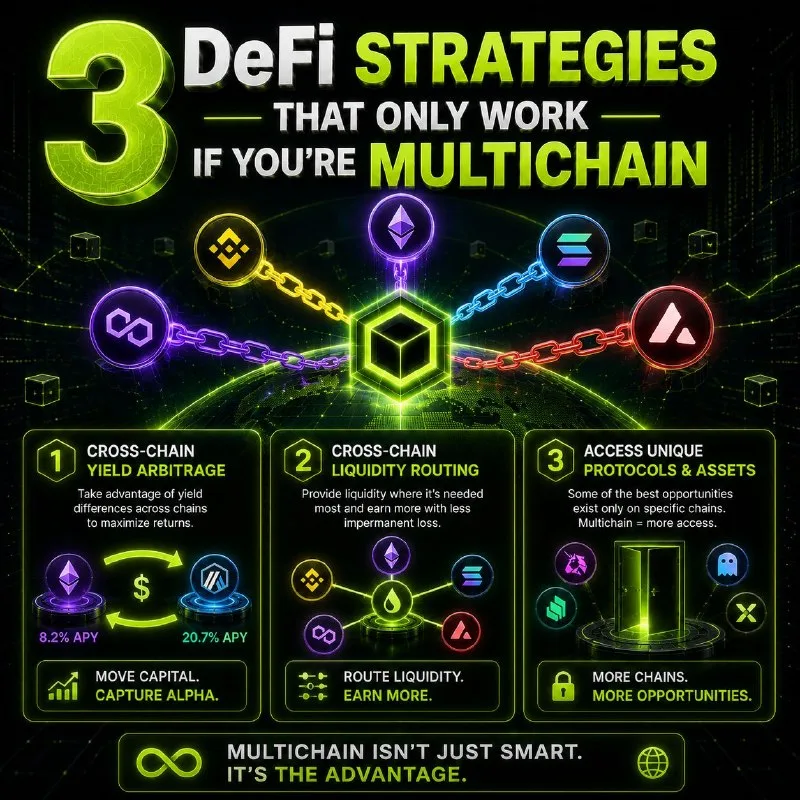
Three DeFi Strategies That Only Work If You're Multichain
One network means one set of opportunities. Multichain means dozens of combinations. The difference is not convenience — it is arithmetic. Some strategies only exist if your capital can move between chains quickly, cheaply, and on demand.
Here are three such strategies. Each one is real, each one fails on a single chain, and each one becomes practical the moment a fast cross-chain route is available.
Strategy 1: Yield Arbitrage
Differences in approved APY between networks are the cleanest form of free money in DeFi — a stablecoin earning almost nothing on one chain can earn meaningfully on another for the same duration and similar risk. The opportunities change constantly because liquidity and rates rotate between networks.
- Aave USDC on Ethereum: around 4.5% APY
- Aave USDC on Arbitrum: around 7.2% APY
- Aave USDC on Base: around 9.8% APY
Transfer your USDC to the higher-yielding network with Swapcoin and the difference is 5.3% more every year. On $50,000 that is roughly $2,650 a year, minus a one-time route fee. The move is one transaction; the one-time fee is dwarfed by the annual edge.
Strategy 2: Liquidation Hunting
Liquidations happen across different networks, and they are the most time-sensitive opportunities in DeFi. When a position is wiped out, the assets are sold at a discount — but the window lasts minutes, and your capital has to be where the liquidation occurs before it closes.
The multichain advantage is positioning. Keep collateral on a low-gas network ready to deploy, and when a liquidation happens elsewhere, move funds in seconds instead of watching from a different chain. Speed is the entire strategy: the arrival route determines whether you capture the discount.
Strategy 3: Cross-Network Spread Trading
The same asset can trade at different prices on different networks during volatile windows. The strategy is straightforward: buy where it is cheaper, sell where it is more expensive. The spread exists because the networks do not share order books and their participants move at different speeds.
- Token X on Ethereum: $1.00
- Token X on Avalanche (Trader Joe): $1.03
- Per-token edge: $0.02 per token minus fees
On $10,000 and a 3% spread, the potential profit is around $200–250 per trade — if the move is one transaction. The practical version of this is exactly how cross-chain arbitrage works in a single click.
Every strategy needs a wall-breaker
All three strategies exist only because networks disagree. Swapcoin is the wall-breaker that turns the disagreement into a trade.
Why the Math Only Works Multichain
None of this exists inside a single chain. Inside one chain, rates and prices are the same everywhere by definition — there is no spread, and yield differences reduce to finding the best single venue. The edge comes from fragmentation: the same asset holding different prices, and different yields, on separate ledgers.
That fragmentation is exactly the thing an aggregator exploits. It routes across the gap, lets you capture the edge, and makes the whole operation look like a single action. For a sweep of the wider landscape, composability across networks shows how these strategies are becoming the default rather than the exception.
The Costs That Eat the Edge
Every edge has a price: network fees, the 0.1% Swapcoin fee, slippage in thin pools, and price impact on large orders. The strategy is only worth executing when the edge clears the costs — which is why route selection matters as much as the opportunity itself.
For the full breakdown of what a transfer really costs — including the parts that first quotes hide — the true cost of a cross-chain transfer is the honest version of the ledger. And once the math clears, executing is the same flow you already know: pick the route, review the fee, confirm.
Putting It Together
The three strategies are not mutually exclusive. Yield arbitrage parks capital where it earns; liquidation hunting keeps dry powder on a fast network; spread trading turns short-term dislocations into income. A well-run multichain portfolio can run all three at once, because each uses a different slice of capital and a different kind of edge.
The common requirement is the ability to move. That, not the strategy itself, is the competitive advantage.
None of these strategies promise to be effortless, and none should be. What they promise is a reason to keep capital flexible — the moment you can move it cheaply and fast, the strategies stop being theory.
And the rule holds in reverse: a great strategy attached to a slow route is just a paper calculation. Capital that can answer a window in seconds — a liquidation, a spread that closes, a rate that rotates — is capital that can actually collect the edge. The route, not the thesis, is where most trades get lost.
Start small, in one network pair you understand, and only move capital you can afford to leave placed until the edge clears. The flexibility is what makes the risks manageable — and it is also what turns a good strategy into an executed one.