Company
Our Fee Is 0.1% — Fixed, Transparent, No Hidden Markups — Swapcoin Blog
A free DeFi service is a scam or hidden fees. Swapcoin charges a fixed 0.1% built into the rate — predictable, transparent and cost-effective.
Our Fee Is 0.1% — Fixed, Transparent, No Hidden Markups
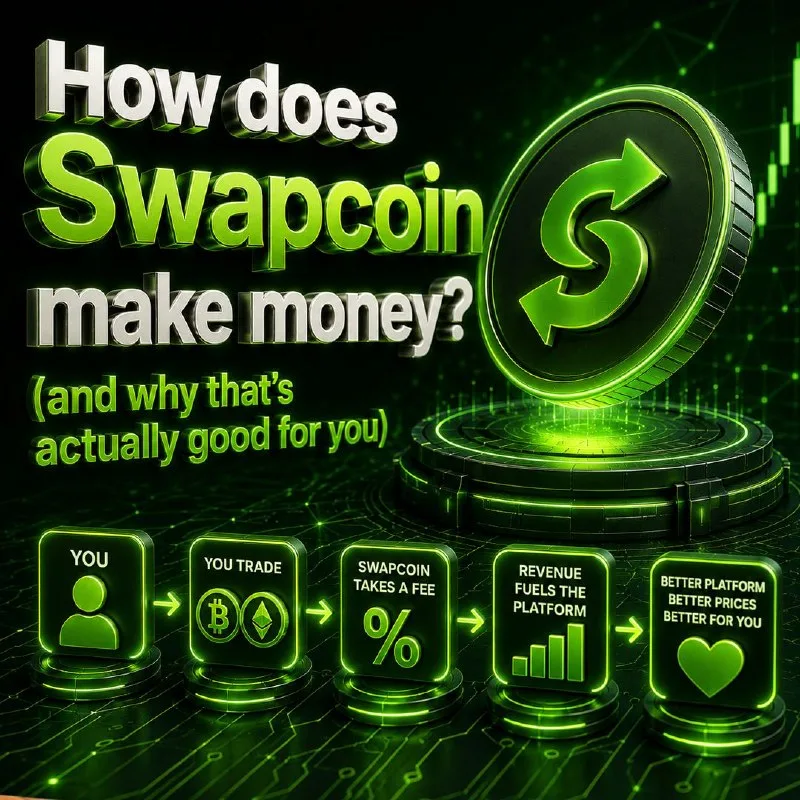
If a service promises "zero fees," the product is usually you. Every payment rail has a cost, and when it is not charged to you in a line item, it comes out of your rate, your spread, or your privacy — somewhere you will not see it until it is too late. Swapcoin takes the opposite approach: the fee is 0.1%, fixed, and printed clearly in every quote.
This is the fee policy written in full, plus the reasons a visible fee protects you better than a "free" one.
Why 0% Is a Red Flag
Bridges, DEXs and exchanges all pay real costs: liquidity, infrastructure, support, risk. A business that charges nothing either subsidizes you hoping for volume or takes the money back invisibly. Inbridges the invisible take is the spread: a rate quoted a fraction of a percent away from the market, which never shows as a fee line.
When a fee is hidden in the rate you cannot compare the offer to the market, so you cannot tell the free service from the expensive one. That is the exact failure the true cost of a cross-chain transfer describes.
What the 0.1% Actually Buys
- Route aggregation across 23 bridges and 25 DEXs — the engine that finds the best leg combination
- Live, confirmed quotes that display the receive amount before you sign
- Gas-included options so funds arrive usable on the destination
- Support for 60+ networks and the engineering that keeps routes current
The fee is not a tax on enthusiasm — it prices the infrastructure that replaces the ten tabs of manual comparison. And because it is low and flat, it leaves the route economics to the market instead of forcing the provider to make money by steering you to worse sources.
Where the Hidden Costs Used to Hide
Fees hide in three places: the spread between quoted rate and market, the price impact on your exact size, and follow-up fees you pay later — the destination-gas transfer, the second withdrawal, the "you need our token" conversion. None of these appear on a sticker price.
The fix is structural: a fixed 0.1% plus a receive-based quote makes every leg an open number. What you see is what you get, and the comparison that matters — "does this route beat that route?" — becomes answerable from a single screen. On a large transfer priced against a bank or exchange, the difference is not small.
What You See Is What You Get
The confirmation screen is the contract. It shows source asset, destination asset, the 0.1% line, and — the number that actually matters — the receive amount. If an offer cannot present all four on one screen, the offer is hiding something you will pay for later.
This honesty has a concrete budget effect: the same amount routed through a visible-fee engine reliably lands a better receive total than through a zero-fee storefront whose spread quietly widened.
The Math on a $10,000 Transfer
Let us price it. On a $10,000 cross-chain stablecoin transfer, 0.1% is $10. A zero-fee service charging only 0.2% above market in spread costs $20 — twice as much, invisible, and worse for larger sums because spread compounds with size while a percentage fee does not.
For a $50,000 treasury operation the three differences — 0.1%, market spread, and a receive-based quote — can separate routes by several hundred dollars even when the advertised fees look identical. That is the whole point: treasury-grade routing is not about lower stickers, it is about an honest total.
What the Fee Covers — and What It Never Will
What the 0.1% plainly does not cover is the market's own movement: price impact, the gas the network itself charges on each leg, and the bridge fees of the venues chosen. Those are open numbers on the quote rather than baked into a markup, because baking them in is exactly the opacity this policy removes.
Fifty percent of the value is the visible fee; the other fifty is the refusal to hide anything else. Five features you might have missed rounds out the rest of what the engine does with that budget.
The fee rule in one line
A visible 0.1% allows comparison. A hidden spread prevents it. Prefer the one you can audit.
The transparency principle travels with you. The same question that separates a good swap from a bad one — "where is the fee, and what is the receive amount?" — also separates healthy exchanges from bait-and-switch ones, healthy bridges from spread-funded ones, and healthy vaults from ones that advertise a headline APY while the entry route eats the gains. Asking it once per provider costs nothing and changes the answers you get everywhere.
Fee transparency also stabilizes planning. When every route is priced with a fixed 0.1% and a receive figure, estimates hold their shape: a treasury proposal written on Monday still resembles the executed move on Wednesday. That predictability is worth real money to anyone who budgets in advance, which is most people doing large transfers.