Fees & Savings
When Is Ethereum Gas Cheapest? Timing Your Transfers — Swapcoin Blog
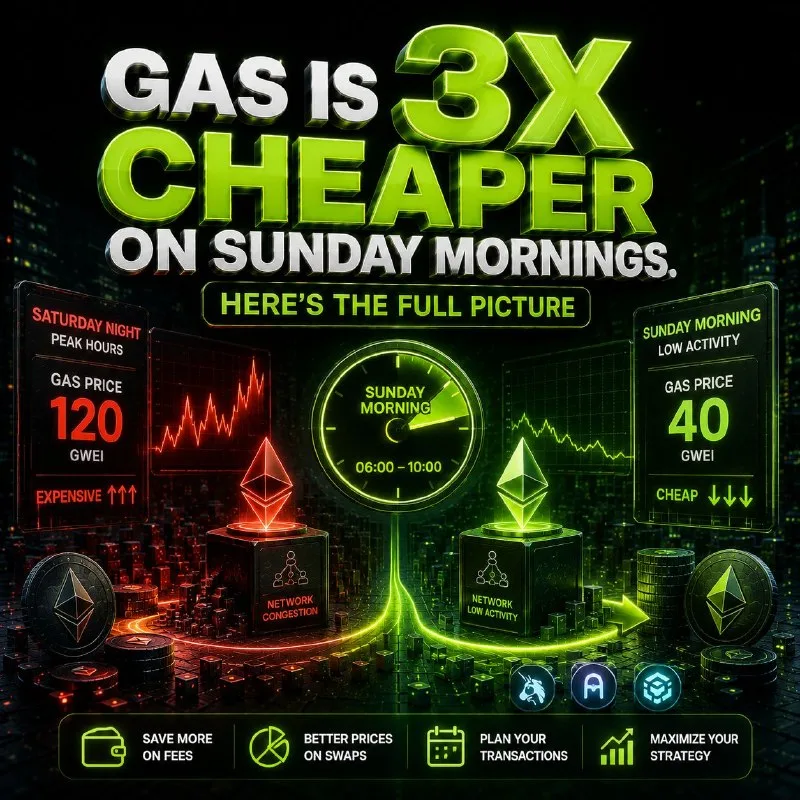
Gas depends on the day, hour and market activity. Sundays are cheapest, Tuesday-Thursday are most expensive. Here's how to time transfers and save hundreds.
When Is Ethereum Gas Cheapest? Timing Your Transfers
“It was $2.10 a minute ago and now it is $42.” Every Ethereum user has had this moment. Gas is not random — it follows weekday and hour rhythms, and once you learn them, you can schedule the expensive moves around the cheap hours instead of paying full price whenever you happen to click.
This guide is about timing: the patterns that make gas cheap or expensive, how they look over a week, and why an aggregator removes the need to chase them by hand.
Why Gas Has a Rhythm
Ethereum gas is a market where demand meets block space. More people wanting the same space means higher fees. The demand is not uniform — a large share of it comes from humans, and humans cluster their activity into certain hours and days. That clustering is why the cheapest moments are the quiet ones: late in the day, overnight, and around weekends.
Networks also inherit attention from events. A token launch, a big Liquid Staking migration, or a spike in NFT volume pulls everyone onto the same chain at once. Predicting those spikes is market timing; predicting the steady rhythm is just reading a calendar.
The Cheapest Hours of the Day
For most of Ethereum's life, the pattern has been consistent: activity peaks during US and European business hours and in the evening window, then drops through late night and overnight. Transfers confirmed between roughly 22:00 and 06:00 UTC land in a much emptier mempool.
- Night: the most consistently cheap hours, when most regions are asleep
- Morning CET: moderate, as Europe wakes up but the US has not started
- US session: the most expensive block of the day, especially mid-afternoon UTC
- Right after a big announcement: the worst time to send anything non-urgent
None of this guarantees a price. But it shifts the odds strongly in your favor, which is all a spending pattern can do.
The Cheapest Days of the Week
The weekly rhythm is even more predictable than the daily one. Weekends — especially Saturday and Sunday morning — consistently see lower gas than the middle of the week. The busy core is Tuesday through Thursday, when institutional flows and weekly activity stack together.
If you are moving a large amount and the transfer is not urgent, moving it to the weekend converts a timing decision into a straight saving. The same transfer that costs $30 on Wednesday can routinely clear for under $5 on a Sunday.
Calendar Events That Change Everything
Evenings and weekends are the baseline, but a single event can overturn them. Token generation events, layer-2 token incentives, liquid staking restaking campaigns, and NFT mints all put thousands of simultaneous transactions into the queue for the same hours they happen.
The practical response is not to out-predict the event — it is to separate the urgent from the schedulable. A transfer that just needs to arrive can wait for the quiet hour. The mistake is paying peak pricing for transactions that are trivially time-shiftable, which is exactly the class of transfer a failed transaction turns into a double bill.
How Timing Interacts With Cross-Chain Fees
Cross-chain transfers are a small chain of transactions: source network, possibly a bridge hop, possibly a swap, then the destination side. Each leg has its own gas market, and only the source leg is on Ethereum. Timing Ethereum cheaply does not automatically time the other chains — but it is the leg that usually dominates the cost.
An aggregator that schedules and sequences these legs removes the arithmetic. Instead of you checking three fee markets, one route proposal accounts for all of them, including the hidden components inside a cross-chain transfer that gas charts never show.
What Swapcoin Does With the Clock
Swapcoin's route engine looks at the live state of every leg before proposing a route. Gas prices are read as part of the quote, not approximated afterwards — and the quote is quoted in full on the confirmation screen.
You still decide when to go, but you no longer have to estimate what going costs. For the moments that genuinely cannot wait, the gas-included flows mean you arrive with funds usable on the destination, as explained in how arriving with gas included works. For everything else, pick a Sunday and let the market be quiet while you move.
The timing rule in one line
Gas follows people, not physics. Send the schedulable transfers in the quiet hours and let the route engine price the rest for you.
One practical note: cheap hours belong to schedulable transfers. If a move is genuinely urgent — a time-sensitive purchase, a liquidation test, a volatile position — waiting for the weekend can cost more than the gas you saved. The useful distinction is not "always wait for cheap" but "wait when your transfer is not on the clock," which most wallet-to-wallet moves are not.
For the moves that do wait, the wiring matters more than the hour. A route that combines a bridge and a swap poorly will waste its advantage regardless of when you send it, while a well-split route keeps the saving at every minute of the day. Timing and routing complement each other: the cheap hour keeps the network cost down, the good route keeps the spread down, and the total is what your receive amount reflects.
The same logic extends to the assets themselves. Stablecoins move calmly and schedule well; a volatile small-cap with thin liquidity can drift while you wait, so its route should be evaluated on receive amount rather than on the hour you happened to see it. When you know both the asset's behavior and the network's rhythm, the scheduling decision stops being guessing and becomes a repeatable routine.